

Multi nodal soil movement detection.
A turnkey sensing network that replaces manual survey work: small MEMS inclinometer nodes sharing one long CAN bus in parallel, so a failed node never cuts off the rest, an ML decision tree model for arcsecond resolution, and a cloud platform that runs from device provisioning to a live 3D view of the string.
- Client
- Mikrosense
- Sector
- Industrial IoT
- Year
- 2023/24
- Our role
- Turnkey, from sensor to cloud
Long reach, small nodes.
Soil movement has long been measured by hand, a slow survey that is easy to get wrong and gives only a few readings along a slope. Mikrosense wanted a string of sensors that could sit in the ground and report continuously, with enough spatial resolution to see where the soil is moving.
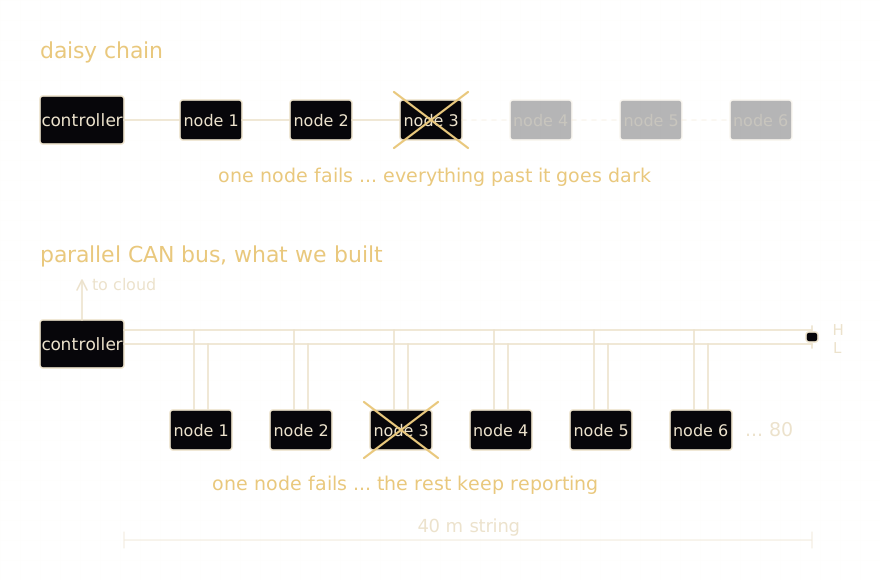
The hard part was the string itself. Readings had to travel the full 40 m run to the controller with their signal integrity intact, while each node stayed small enough to seal in a slim epoxy shell around the cable. And once a string is in the ground, nobody can reach a node to fix it. Wired in series, one failed node would cut off every node beyond it.
So the 80 nodes had to share one bus in parallel, without collisions or bottlenecks, and keep reporting whatever happens to their neighbours. Once installed, each node can also end up twisted or kinked, so its raw readings no longer line up with the others.
From node to 3D model.
- 01
Sensor node
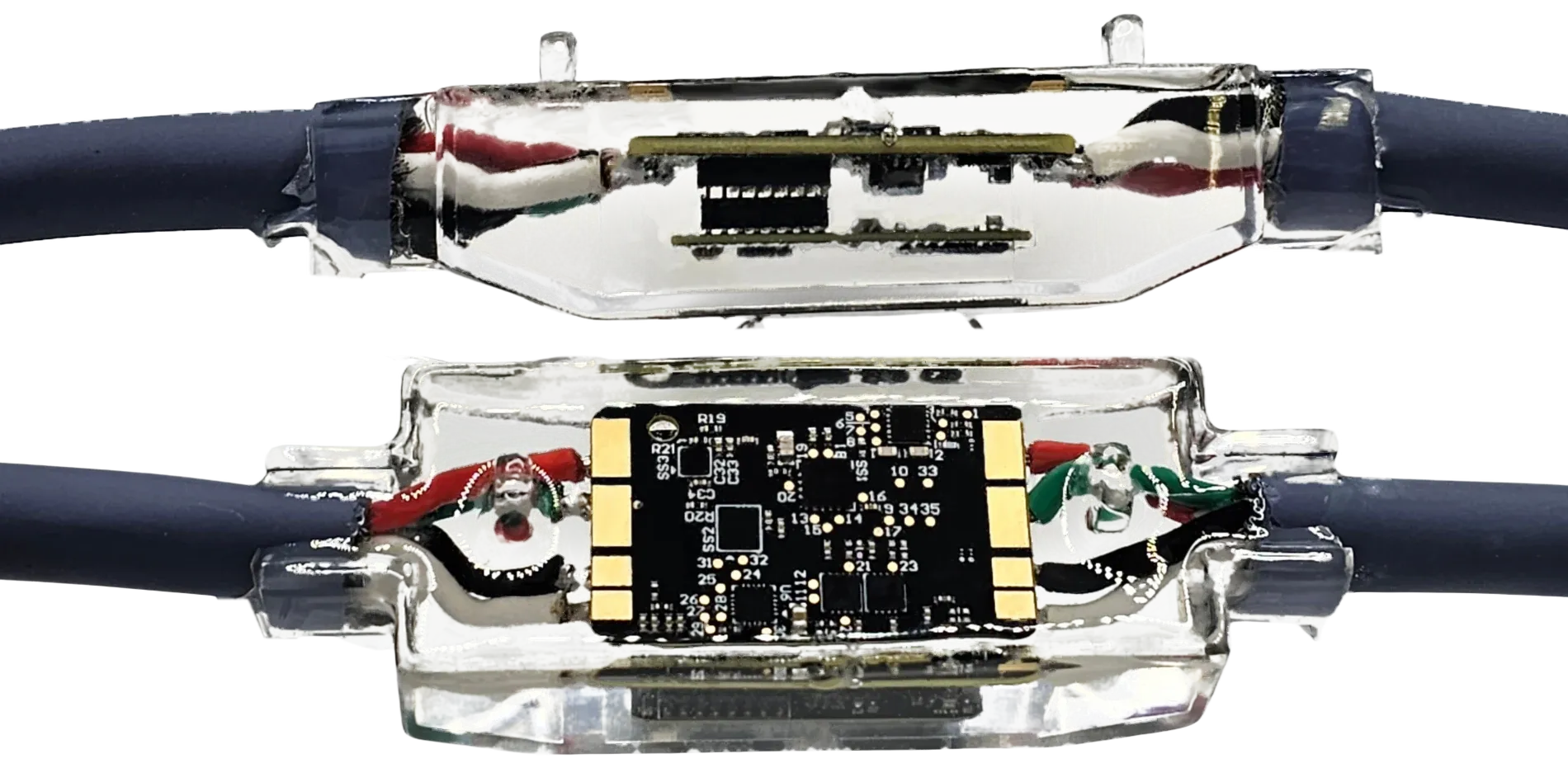
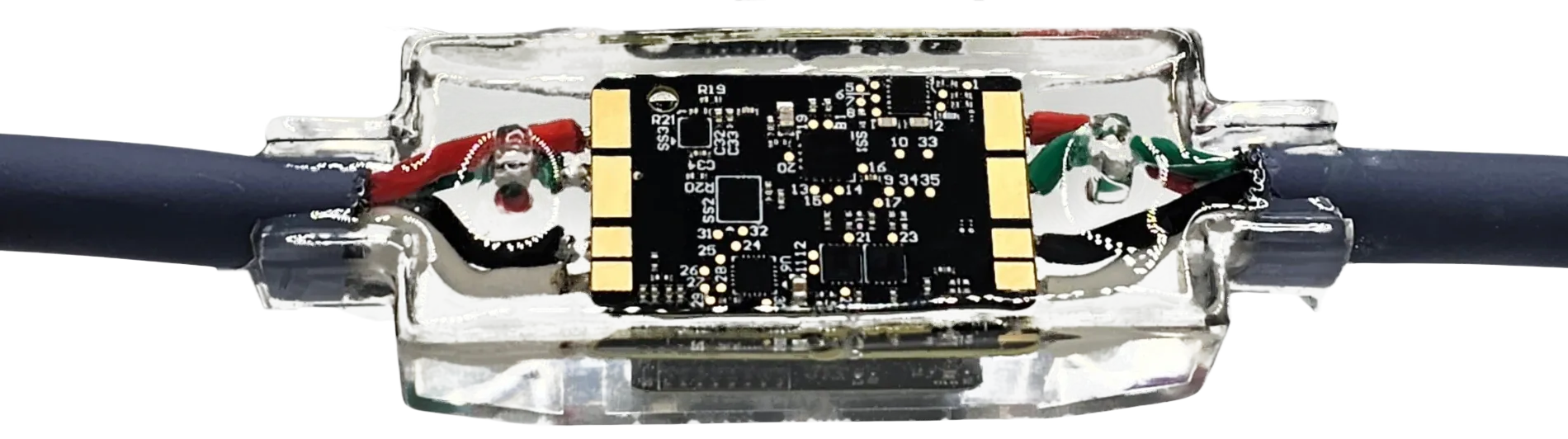
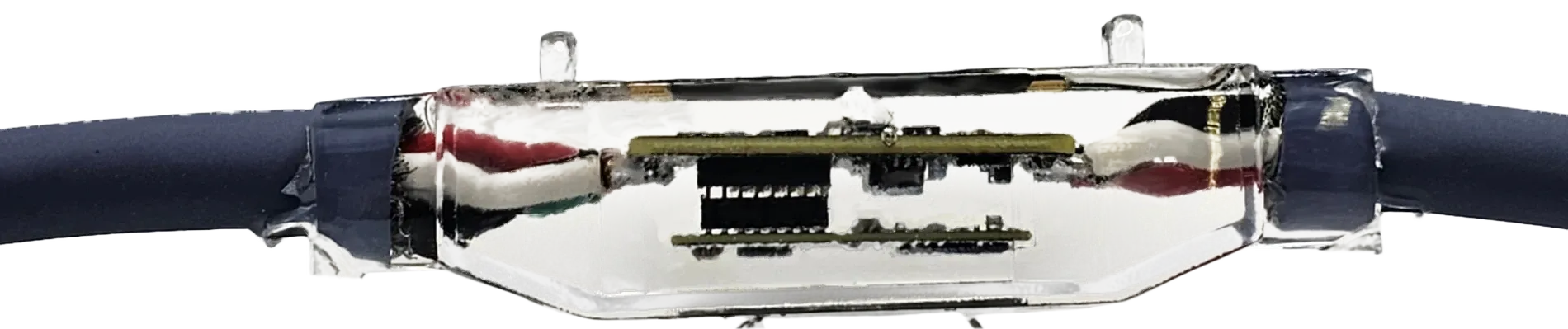
A precise MEMS tilt sensor and its bus interface on two small stacked boards, read through our own algorithm and sealed in clear epoxy around the cable for life underground.
- 02
Parallel CAN bus
Every node taps the same differential pair instead of passing data down a chain, so a failed node drops off the bus and the rest keep reporting. We designed the bus and its protocol to carry 80 nodes over a 40 m string, with network load and collisions managed so every reading arrives intact.
- 03
Why CAN, not RS-485
RS-485 only defines the wires and voltages, so it needs a protocol such as Modbus on top, and its reliability then rests on a custom implementation. CAN brings arbitration, CRC checks, acknowledgement, automatic retransmission and fault confinement in the controller silicon, a stack proven over decades in vehicles and industry. A node that keeps sending errors takes itself off the bus, which is exactly what a long string needs.
- 04
Controller
A controller module at the head of the string gathers the readings and reports them from remote sites.
- 05
Cloud IoT platform
We built the platform for the whole IoT process, from provisioning controllers onto organisations and sites, through ingesting and storing every reading, to threshold alerts, uptime, team roles, an action log and data export.
- 06
Visualisation
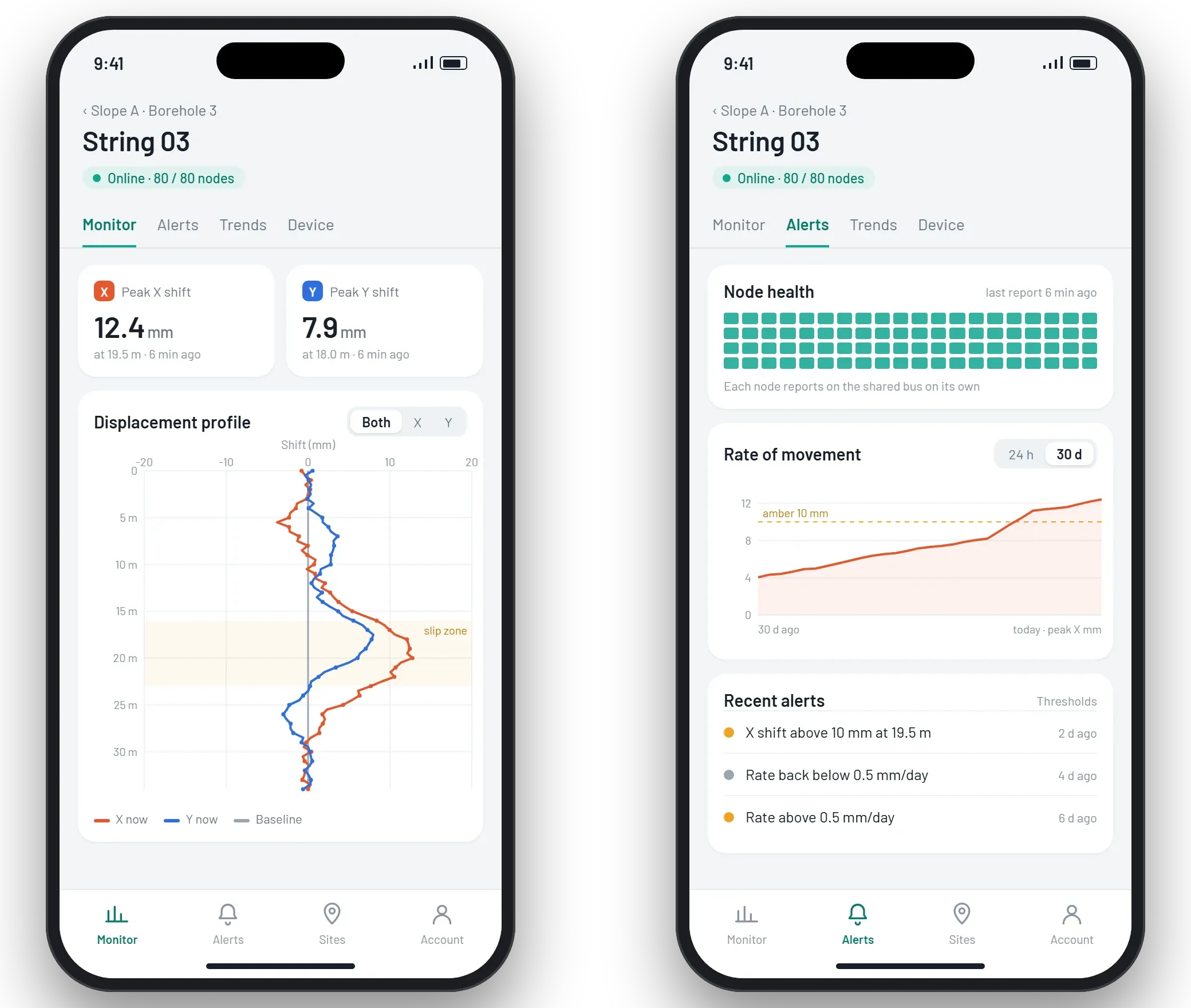
Web and mobile dashboards plot each string's displacement against depth beside its baseline, and the 3D view corrects for each node's orientation and position so the data stays accurate however the string was laid.
Ground truth, continuously.
The system replaces manual, error prone surveys with continuous, high resolution data that reaches the people who need it on the web and on their phones, with alerts when the ground starts to move. Accuracy and detail that once took a team in the field now arrive without anyone on site.
Every part, from the sensor node and its bus to the cloud platform and the app, was designed and tested by our team.